Postmodern Blackness, by Hooks was interesting to me because it was written in a way that I could understand it. He is a black man that is dealing and questioning himself and our postmodern world. He is in the position that he knows that people may oppose what he is saying that that “his discourse has no ready audience, no clear listener, and that his voice may not be heard.” I found this interesting that he used the tactic of not just throwing a bunch of facts or opinions at the readers, but by stating his opinion and then stating that he may be wrong or not have ready listeners. I found it interesting that he placed himself in a lot of the stereotypes that he discusses, in particular when he says that he was the only other black man in the room. This particular example, of the “token black guy” has started to seep into our culture through media, movies in particular. Hooks explains how postmodernism has no relevance at all to African-American people, especially women. He describes how he feels as if he is an outsider when reading the conventional language that poster modernism is written it. He feels, along with other blacks, an outsider of the discourse looking in. I found it interesting how he described how poster modernism could be seen as people of elite or higher authority. This in turn, pushes minorities away and out of the picture completely. This connects with the idea that some white people, who absorb white supremacy thinking, don’t even notice black people and what they have done to be successful. The final point that I wanted to discuss was the aspect of music. It is concerning that this was one of the main aspects of the article that shed a positive light on something that African-American people have done. It is the cultural product that is most interesting and attractive to postmodern theorists.
Showing posts with label week #13. Show all posts
Showing posts with label week #13. Show all posts
Friday, November 19, 2010

Tuesday, November 16, 2010
Comedic News and Entertainment
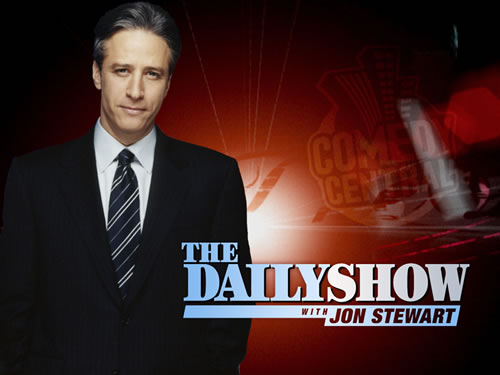
In Geoffrey Bayms article, "The Daily Show: Discursive Integration and the Reinvention of Political Journalism," he talks about how other sources of news are appearing. People seem to be more interested in watching a comedic form of news than the standard cable TV newscasts. He states that, "young people are turning towards another form of news and campaign information--late night television and comedy shows. The 2004 Pew survey found that 21% of people ages 18-29 say that they regularly learn news and politics from comedy shows such as Saturday Night Live, and 13% report learning from late-night talk shows such as NBC's Tonight Show with Jay Leno and CBS's Late Show with David Letterman." Jon Stewart considers his show as "fake news." What makes this pretty funny is that people tune into his show regularly, and it happens to be a huge influence with political communication. The Daily show is a form of entertainment that a younger generation tunes into regularly since it is on Comedy Central. The show has more of a liberal point of view, and when they talk about the Republicans, they do it in a comedic fashion. The article also explained that the Daily Show poses a threat to mainstream news media because it is more for entertainment.
"The Daily Show" as Sub-culture
In the Baym piece about "The Daily Show," the author points out how the show juxtaposes comedy and news reporting in a fresh way. It is the combination of these two seemingly incompatible aspects that makes the show successful. I was reminded of our class discussion the other day; we talked about appropriation andre-appropriation. It seems like "The Daily Show" is doing something similar to the sub-cultures we discussed, appropriating signifiers that don't fit its "class." We said that HipHop is associated with Escalades and Bentleys, also, diamonds, gold, and especially platinum. We also deconstructed Punk; Dock Martins, ripped jeans, clothes held together with safety pins. Both subcultures appropriated signifiers not associated with the class of the people who established the music around which the styles evolved. Just like Hip Hop and Punk, "The Daily Show" is appropriating signifiers of comedy shows as a means of forging a new identity and rebelling. On the surface, the show seems like it is purely comedy, but as the article pointed out, the news content really does a good job of relaying pertinent and critical information to its audience.


Subscribe to:
Comments (Atom)