Showing posts with label Week 3 - Ideology and Identity. Show all posts

Tuesday, September 7, 2010

What Women Want: From Romance Novels to Oprah's Talk Show


Janice A. Radway’s “Women Read the Romance” provides a detailed account of why women read romance novels. Through talking with bookstore employee Dot Evans and interviewing her customers who frequently read romances, Radway explains that women mostly read romance novels as a way to escape. She goes on to clarify that women seek to flee from their mundane roles as mother and wife (typically, romance readers are middle-class, married, mothers). Additionally, women who are dissatisfied with their husband or boyfriend at the time find the perfect male through reading. They live vicariously through the life of the heroine and take a “small vacation from everyday life” (69). The text continues by describing romance books as barriers between themselves and the outside world. Women feel the need to believe in a fairy tale and look forw

ard to curling up with a novel. According to Radway, most women believe books provide a better alternative to television because books are “educational” and contain greater cultural value. Overall, women enjoy reading romances because they provide them with the illusion of safety and security through a powerful but sensitive male figure and because they provide the reader with hope, pleasure and happiness. Women would rather read about the deep, emotional connection between a woman and man then read about explicit sexuality. Despite the fact that most romances progress and end in the same way, women still turn to them when their marriage fails to “address all their (emotional) needs” (75). The image I chose represents the desire women feel to “escape.” It involves the perfect hero (in this case, a man who can dance) and conveys beautiful images of mermaids and hammocks on the beach. The hammock even says “perfect bliss” on it, signifying that this scenario is flawless compared to the faults of everyday life. When you look at this woman, you don’t think “mother” or “wife.” You think of a completely relaxed woman who’s found exactly what’s she’s looking for. Perhaps that is the feeling women seek when they settle down with a good romance novel in hand.

Sujata Moorti’s “Cathartic Confessions of Emancipatory Texts? Rape Narratives on The Oprah Winfrey Show” also deals with women’s issues. This text includes an ongoing debate about how significant Oprah’s show is, and in what ways. On one hand, the show provides women with the chance to voice their experiences (in this case, the reading primarily deals with rape victims). It allows for debate over controversial topics, such as date rape, and often follows a problemàsolution format. Oprah’s show is significantly different from the news because she focuses on individuals and their personal experiences rather than a general issue. However, Oprah still backs up her points with statistics and research. Also unlike the news, Oprah discusses the emotional toll that crimes such as rape take. Additionally, she tries to provide rebuttals to her arguments. For example, she had an accused male rapist on the show to discuss the male perspective. Nonetheless, the show is targeted so obviously for women. This fact, in combination with the fact that the show does not always focus on serious issues, urges some critics to dismiss the show as nothing more than a platform for conservation and debate. Such critics advocate that most of what the show does is simply to “get an audience” (523). Overall, it seems like “The Oprah show” helps empower women through voicing individual stories, providing possible solutions and general advice, and by promoting learning and discussion on to women-related issues. I picked the displayed image because much of this reading focuses on the importance of communication. For example, many people involved with rape said one of the main causes was miscommunication, or lack of communication altogether. Additionally, by conversing and debating, people can learn the difference between myth and reality. For example, many people believe that strangers conduct the majority of rapes. Oprah disproves this by bringing in people who have been raped by people they know and backing up her argument with facts and data.


Media and feminism


Women Read the Romance is a study of women, specifically wives and mothers, who read romance novels for pleasure and enjoyment. For every woman who was interviewed, there was a common factor. Each woman enjoyed reading these romance novels because it was an escape from their everyday lives. They responded with answers like "They always seem like an escape and they usually turn out the way you wish your life was."(69) Not only do these women enjoy this escape from reality (literally and figuratively) but they also enjoy these novels because they can be a realistic fantasy. For example, romance novels have the hero and the heroin, with the hero balancing both masculinity and nurturing qualities. This combination is most certainly a fantasy for many women. Women are nurturing by nature, therefore leaving them exhausted when nurturing is not received. The idea of having a man who encompasses masculinity and is nurturing is what sparks women's interest in these novels. Therefore these novels give women a sense of nurture by describing what women desire.


Cathartic Confessions or Emancipatory Texts? discusses day time talk shows, concentrating on Rape Narratives on the Oprah Winfrey Show. The point that Moorti was trying to accomplish was that although the Oprah show does help discussion on social issues like rape, there are hidden agendas. The Oprah Winfrey show is based on discussion and debate, she brings in professionals, experts, and victims of whatever situation is being discussed for the day. However the hidden agenda depends on the topic, and who she brings in for the day. According to Moorti, Oprah has proved to contradict herself on different days with similar topics, such as rape. For Oprah, the purpose is to appeal to the audience so ratings can increase. This occurs by exploiting the oppression of women. This may not be the intention of day time talk shows, however this discussion of oppression appeals to the female audience, who can relate to the topics discussed.


Women Read The Romance …Ooo la la

This article talked about two different types of groups who read romance novels to fulfill their yearning for a perfect relationship with a man. The Smithton women read the novels for relaxation and an escape from their present surroundings, as one woman put it, "My body may be in the room, but i'm not!" (69) . The fantasy world of romance novels spark women's interest because they aren't boring like the newspapers and TV new, which I can totally agree with that!
Chodorow view is based on the Freudian concept of nurturing. That men have a hard time fulfilling a women's emotional needs because they find it unfamiliar and difficult. This is because woman have been known to believe that men are the source of pleasure, but mens socialization by what the ideal family should be prevents them to nurture women in the way they wish to be. "They long for emotional attention and tender care; on the other hand, they wish to rehearse the discovery that man's distance can be explained and excused has his way of expressing love." (75).


This image of the movie Mr. and Mrs. Smith I thought relates to both Smithton's and Chodorow's view on romance novels. It's about a married couple who are hot and heavy when they have time off of work, which is what Smithton's long for when they escape reading a novel. But on the other hand, the couple is out to kill the other one making it hard for the woman to be nurtured all the time because her husband is trying to aggressively kill her, which is what Chodorow argues.


The "Rape Narratives on The Oprah Winfrey Show" reading basically analyzed Oprah's show on date rape and how it relates to women's empowerment and feminism. The article talks about so much, I don't even know where to begin. Oprah invites a panel of experts to discuss valid ways to understand the topic of rape more to the victims. One recognizing "movement from object to subject." (526). I also think a good part about understanding rape is learning the statistics. Oprah gives out statistics which highlights how prevalent the crime really is. I thought the statistic of high school boys and girls view on rape was astonishing. The boys saying it's okay to rape a girl if they paid for their date/dating someone for 6 months validates them to rape a girl? And then some of the girls agreeing to that? It is very true though, girls can be easily manipulated and just agree to have sex with their boyfriends without even realizing its considered rape. Oprah's show about rape…or any issue is effectively diplomatic, balanced, and educating. Having women openly describe their situation, having an actual rapist explain his thinking, having the audience interact and ask question to the guest, then the panel to add professional information makes for a great show that anyone could watch.
This picture of a woman hiding her face from the shadow of the guy in front of her suggests that she is afraid of what he can do next, which basically shows his power over her and could possible do whatever he wants to her.

Stepping Away From Reality...


In Radway’s Women Read the Romance, she talks about how a certain demographic of women seem to find happiness in reading romance novels. The women in the study suggest that reading a romance novel is an escape. They are little fantasies that give women the opportunity to relax and step away from their busy everyday lives. One woman exclaimed, “Romances hold my interest and do not leave me depressed or up in the air at the end like many modern day books tend to do” (69). In reading an intriguin

g novel, it gives the reader a chance to put themselves in the character’s shoes and become a part of the story, away from reality.

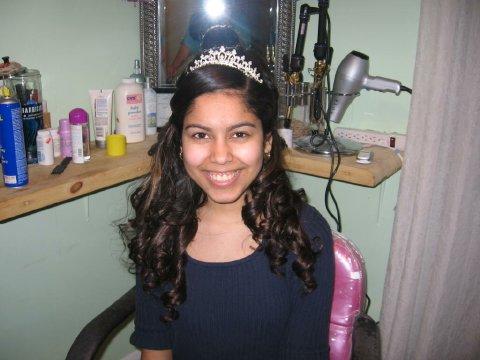
The picture of the girl wearing the tiara says it all to me… She is an average teenage girl, going to get her hair done for a special occasion. Getting her hair done and wearing a tiara helps her step out of reality and feel like sheis on cloud nine. This is what the Smithton readers were to me – they needed an escape from reality and a chance to try out someone else’s life and feel special.


In Cathartic Confessions or Emancipatory Texts, Moorti shows how television programs like Oprah give individuals the chance to tell their stories, whereas other television shows are more generalized. Oprah had several rape episodes that aired between 1989 and 1991 that helped

show America rape victim’s stories and how to resolve their issues. Oprah seemed to almost be trying to act as their therapist or priest, trying to pry out details from them and divulge what they were truly thinking during their frightening encounter. She was especially provoking them to show the “real pain” of the victims and to try to get America to relate to them. Oprah got women to “admit to a loss of confidence and an inability to trust her judgment about people” (528).

To me, this picture describes Oprah perfectly. Lucy, although she is not a therapist, is posing as one, just like Oprah does, to get others to divulge their issues. She asks her guests questions that they may be uncomfortable answering, but disclose to her regardless.